


Dubai, 4 September 2025: The Mohammed bin Rashid Al Maktoum Knowledge Foundation (MBRF) released a collection of critical studies encompassing poetry, narratives, and literary texts, as part of the Dubai International Program for Writing (DIPW). MBRF launched the DIPW initiative to enrich Arabic libraries with prominent publications that meet the needs of scholars and readers seeking reliable resources to expand their knowledge and support their research, especially in the field of applied criticism.
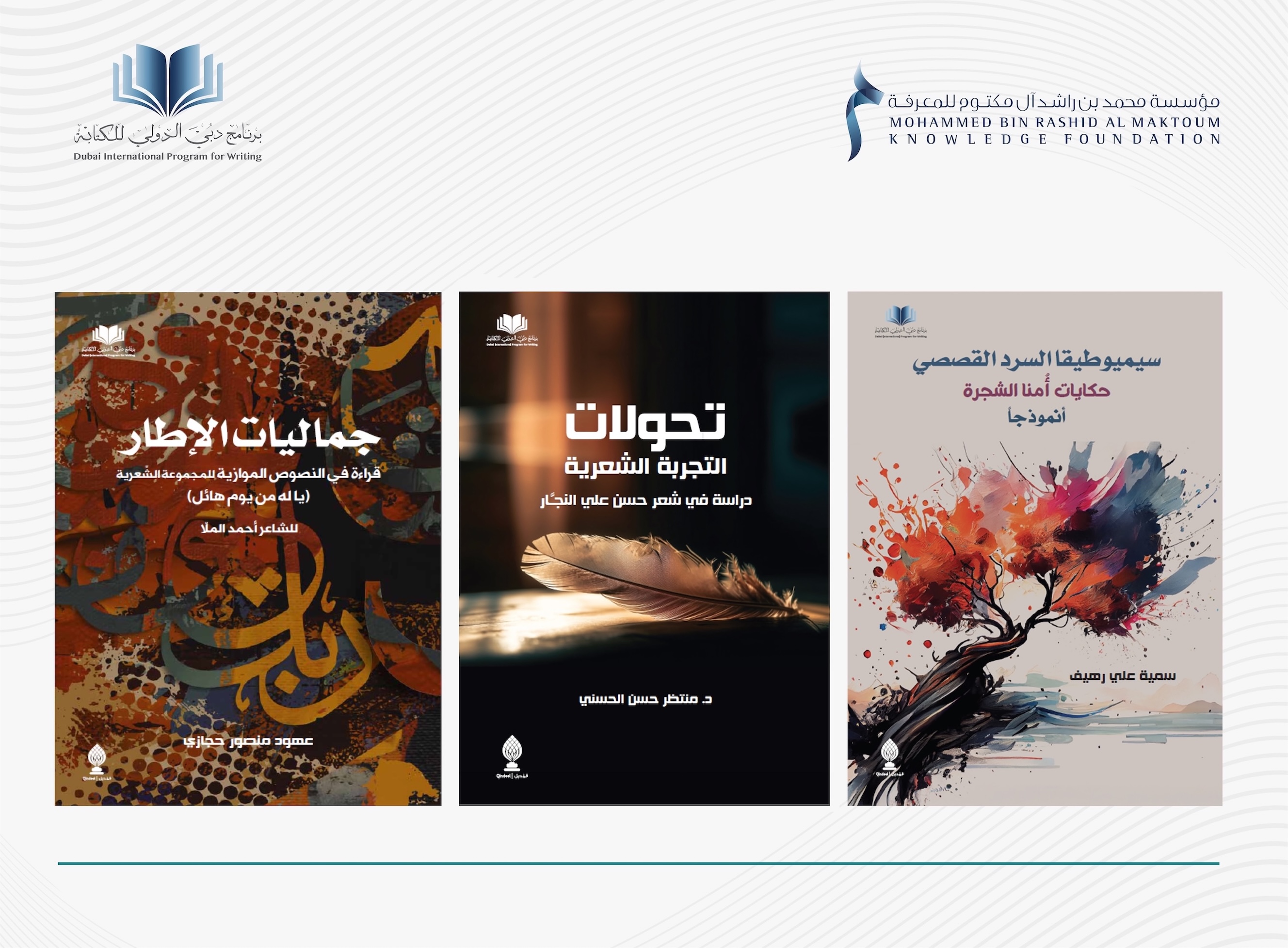
In his book ‘Transformations of Poetic Experience’, Dr. Montadhar Hassan Al-Hasani critically examines the emotional and artistic transformations of poet Hassan Ali Alnajjar, following Alnajjar’s journey through poems, visions, and the ideas portrayed in his poetic themes. It provides a comprehensive breakdown of the semantic codes embedded in his poetic trajectory. It goes beyond ordinary linguistic settings to reveal Alnajjar's unique poetic language, where seemingly diverse meanings coalesce into cohesive goals and ideas.
Meanwhile, Uhoud Mansour Hijazi’s ‘Aesthetics of the Frame’ is an exceptional critical work that explores how framing influences the perception of poetic imagery, emphasizing intricate details, and shapes the internal structure and coherence of the text. The author explains that texts, like images, are inextricably linked to their contextual elements, which are rich in hidden meanings revealed by the decoding of their symbols. She uses this approach to Ahmed Al Mulla’s poetry book ‘What a Great Day’, analyzing the interplay between his distinctive poetic texts and the accompanying artwork by a sensitive and intelligent visual artist, resulting in a rich and layered creative work.
Sumaya Ali Rahif's work ‘Semiotics of Narrative’ critiques the short story forms in the collection ‘Tales of Our Mother Tree.’ Her analysis is based on psychological and sociological aspects, with daily life serving as the fabric that shapes the stories and inspires their suggestive and explicit interpretations. The author states that semiotics is the most effective method for capturing the symbolic depth of these narratives, following the storyteller’s uniqueness and distinctive voice while shedding light on the text’s intellectual, emotional, literary, and artistic components. When applied to literary works, particularly short stories, this technique results in a comprehensive and informative examination of their structural and artistic features.